Christians have always found ways of reading the psalms. After all, Psalms is by far the book most quoted in the New Testament. Most often reading the Psalms is a way to clear the mind and heart and focus on God before prayer, Bible reading, quiet time, or devotions.
One way is to read the Psalms regularly. Many have decided to read five Psalms a day, reading through the entire book every month. Or you could read three, or one a day. That way you keep coming back over the weeks and months, starting to recognize passages again and again, in different times in your life.
Another way is to read one Psalm over and over, in the same sitting, same day, or even same week. In each re-reading the scripture comes to speak to you in different ways; you see the Psalm a bit differently. You may intentionally re-read the Psalm asking: “What does this say about God? Or about the world?” “What is God saying to me, right now?”
Inspired scripture deserves our time and attention.
Psalm 30 is a Hymn of Thanksgiving, a hymn of one totally committed to God. The speaker thanks God for having saved him from sickness and disaster, though we don’t know specifically what. Then he invites the congregation of believers to join in his praise
In the middle he remembers when his world came crashing down, and God seemed to disappear. Then he pleads to God, arguing for his help. Finally, again he claims the joy that God has given him in saving him: “You have turned my wailing into dancing!”
We had said the Psalms often tell a story. One of the most prominent stories is the one that starts in our comfortable orientation, where everything seems good; moves to an unsettling, maybe crushing disorientation; through to a re-orientation where God rearranges the pieces and puts them back together.
We are all trying to see the meaning of our world and make choices that make sense of the present and that move toward the future. But we can’t always see clearly, and there are always twists and turns, as if our “life GPS”, in small and big ways, is constantly saying “recalculating”. Often we are focusing on these few pieces of the jigsaw puzzle, when if we just looked at the picture on the box, we could see which pieces don’t belong and which ones do.
That big picture is what God wants to remind us of. He wants to take us to the mountain top and show us our final destination that will make sense of the twists and turns along the way; even though, as the speaker says in the middle of the Psalm, that reminder may seem like God is “hiding his face” from us.
To give thanks is to make a commitment to God, to hold on to the reality of Jesus, and grow to understand what that means in our lives.
A bit of a reminder of some things we have talked about in group.
Look at the picture of the circles. Which orange circle is larger?
You have probably seen this before, or something like it: a simple question with an obvious, but wrong, answer. The reality is both orange circles are the same size. They appear to us as one smaller, one larger. But why? The blue circles around the orange circles, the distracting context throws our judgement off, keeps us from seeing the reality.
Jesus said that he had come to preach the good news that “the Kingdom of God has come near.” But where is it? Where are we to look? How are we to recognize it?
Jesus said he will return one day and establish a new Heaven and new Earth. He also said the kingdom of Heaven is near; it is at hand. Perhaps it is that there will be some kind of fulfillment or perfection of what we experience now: our world, our lives, our selves set right, completed into what they were meant to be. And that eternity has begun now.
The kingdom of God is near at hand. We must learn to see it as Jesus’s does. We must let him shape the way we see.
What is distracting us from seeing the Kingdom of God?
Where in the Bible do you get glimpses of what the Kingdom of God is like?
But the father said to his servants, ‘Quick! Bring the best robe and put it on him. Put a ring on his finger and sandals on his feet. Bring the fattened calf and kill it. Let’s have a feast and celebrate. (Luke 15:22-23)
The parable of “The Prodigal Son” is in Luke 15. The chapter begins with the Pharisees and teachers of the law getting irritated and bothered about the company Jesus has been keeping. It is just not good to hang around people like that who don’t measure up.
Jesus’s response is to tell a story about going to find the one lost sheep, and finding the one lost coin. I can hear the leaders saying, “OK. Yes, yes. But that’s what we are trying to do – straighten out these lost sheep so they can come into the fold with us.”
Then Jesus tells another story about a father who was insulted and wronged, but went running to meet his son who probably still smelled of the pigs and the slop. He threw his arms around him, and wanted to throw a party.
That’s what Jesus wants to do for us.
How do we follow Jesus in learning to see people that way?
We were standing at the back of the room as the tech team was running through the communion video before the worship service. As a clean, too handsome, movie star like image of Jesus appeared, we all agreed, “He never looked like that.” That was the Hollywood movie style Jesus that walked around with a slight glow about him, feet never really touching the ground, and a faraway look in his eyes.
We don’t know what a photo of Jesus would have looked like. But we do know that we are talking about real history, a particular person, at a particular place, at a particular time.
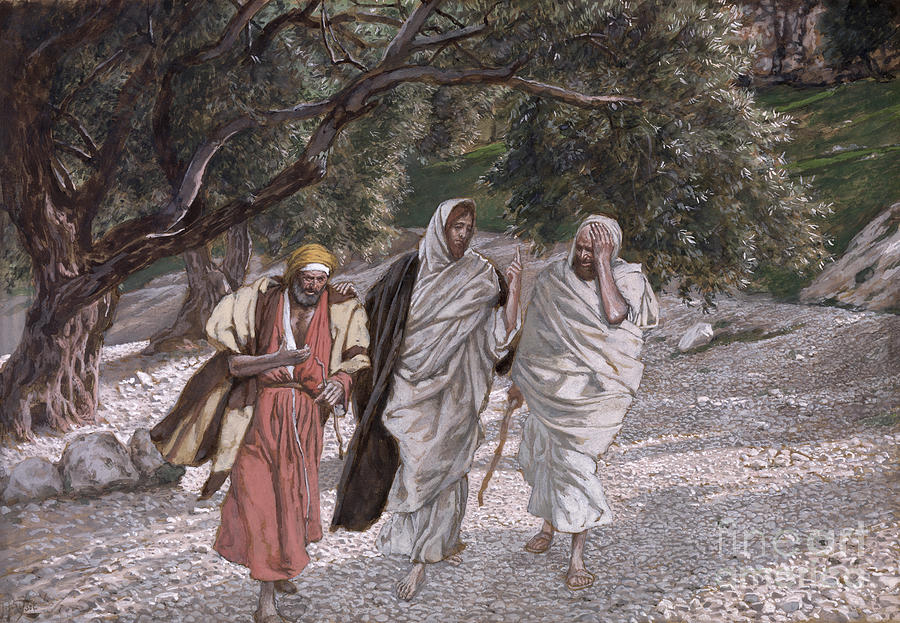
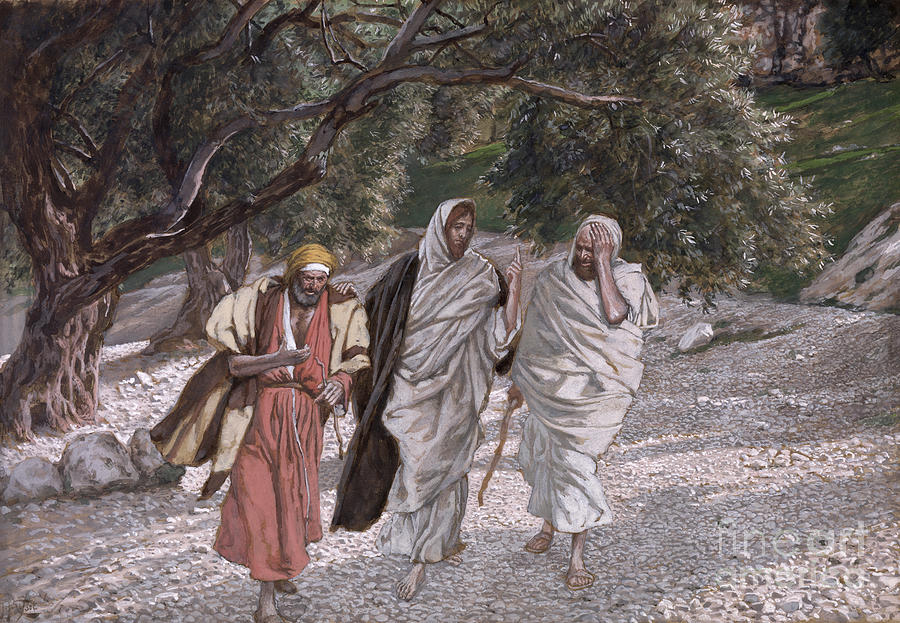
The first painting below is a “more realistic” attempt to portray Jesus and the disciples on the road to Emmaus in Palestine in the first century. Still a bit idealized, it looks like real people in a real situation. I particularly identify with the fellow on the right with his hand to his head. He could be thinking, “I’m so stupid to not to have understood this before,” or “My brain hurts. This is so hard to wrap my head around.”
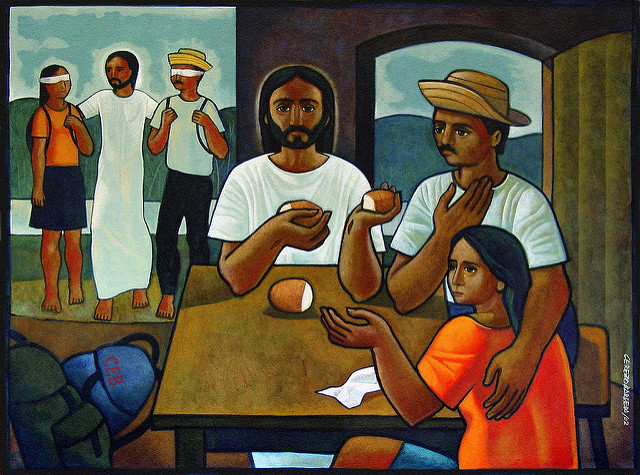
There is the historical presence of Jesus in Palestine, but there is also his presence now, with his people, with those who follow him, whoever and wherever they are.
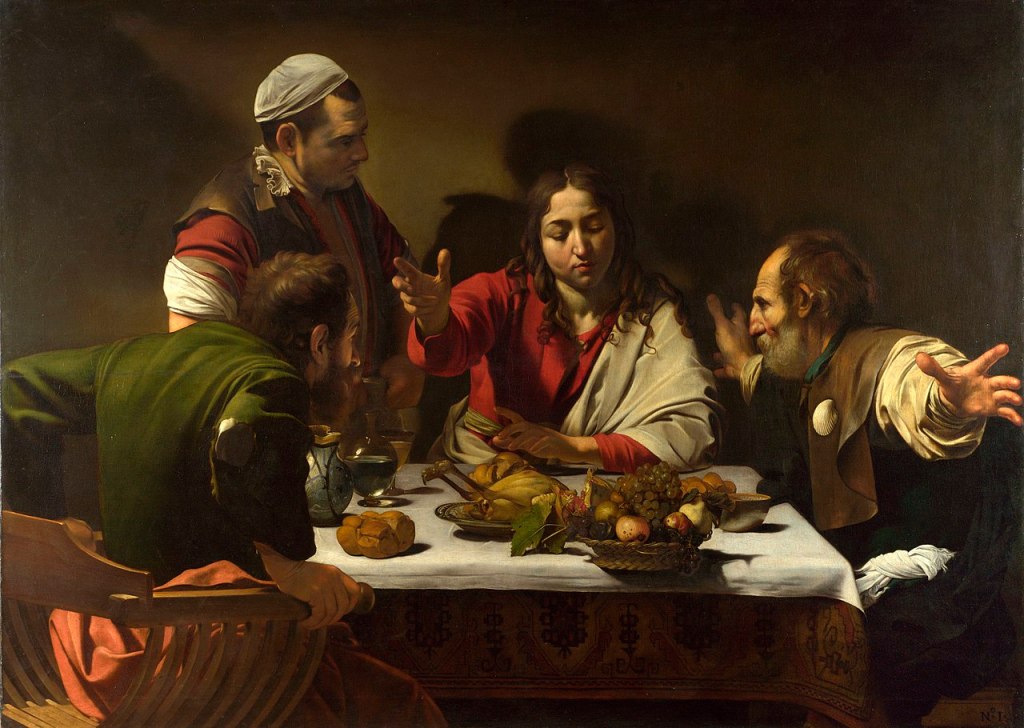
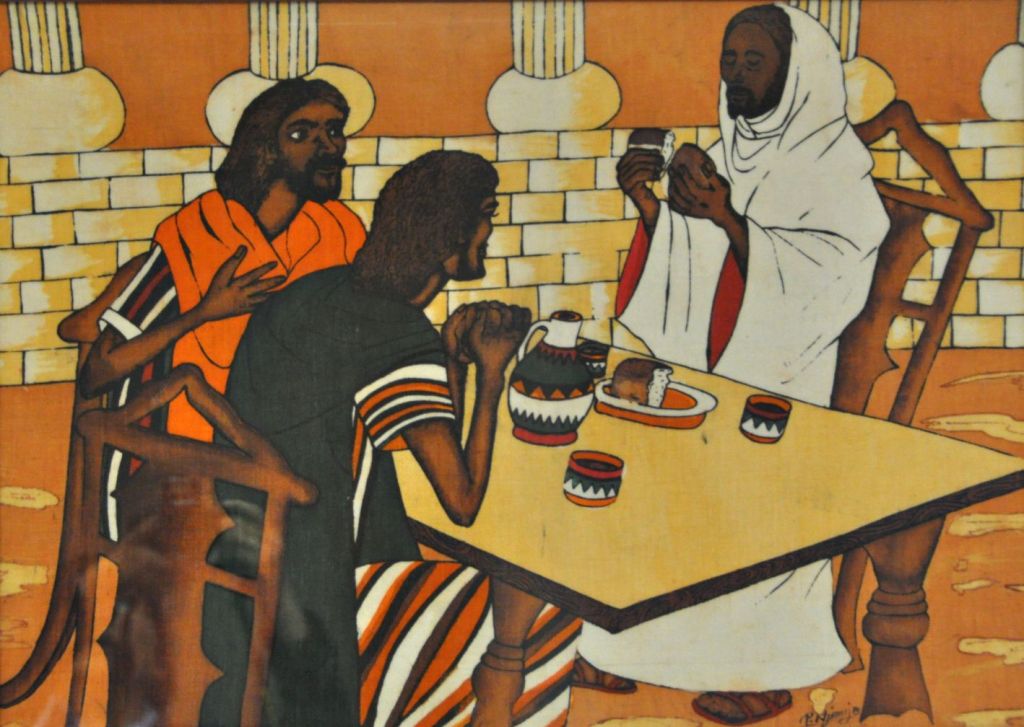
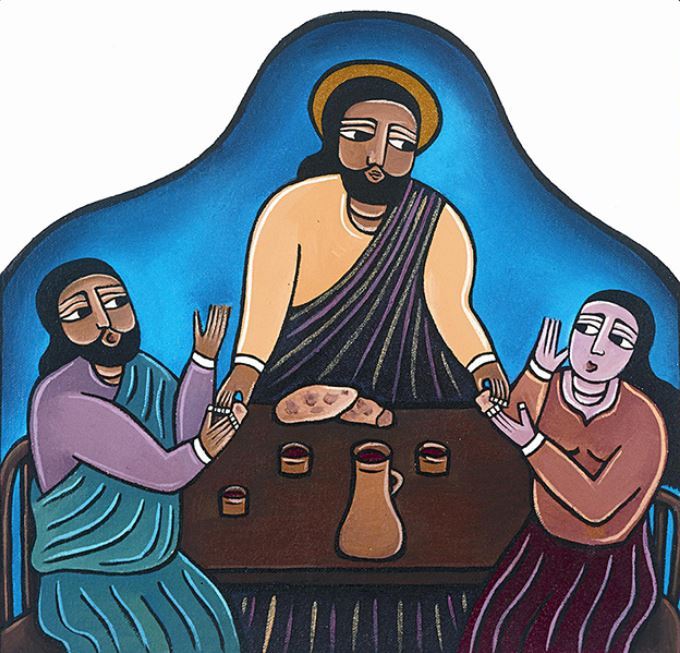
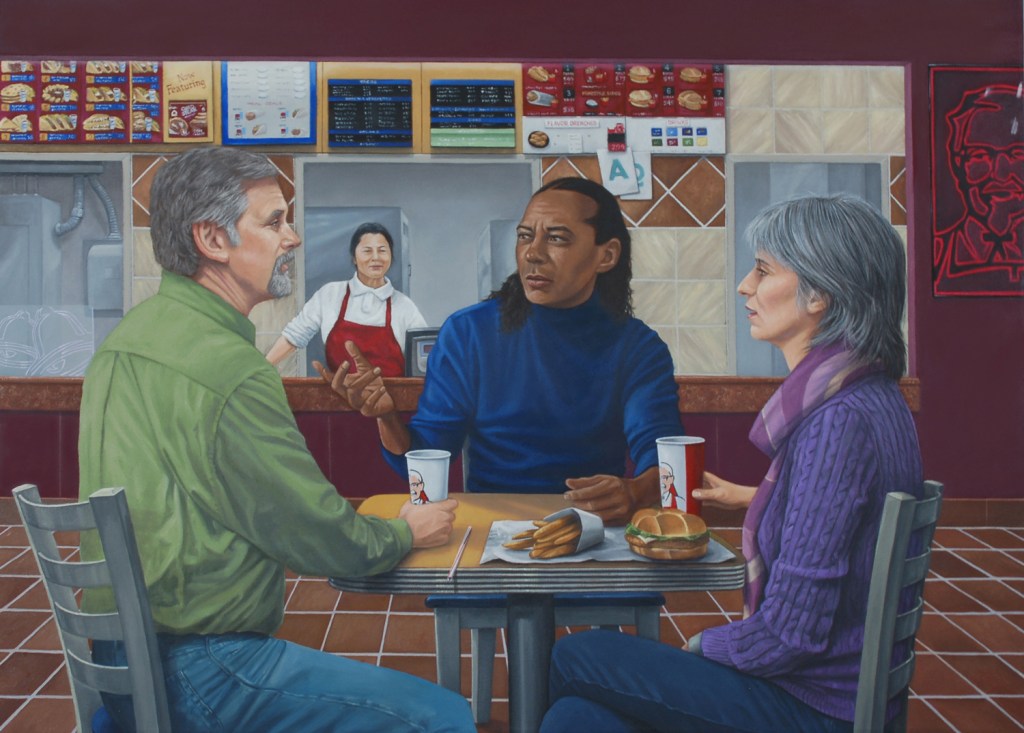
Even the Italian Renaissance painter Caravaggio set the “Supper at Emmaus” in a sixteenth century Italian tavern with typically dressed Italians.
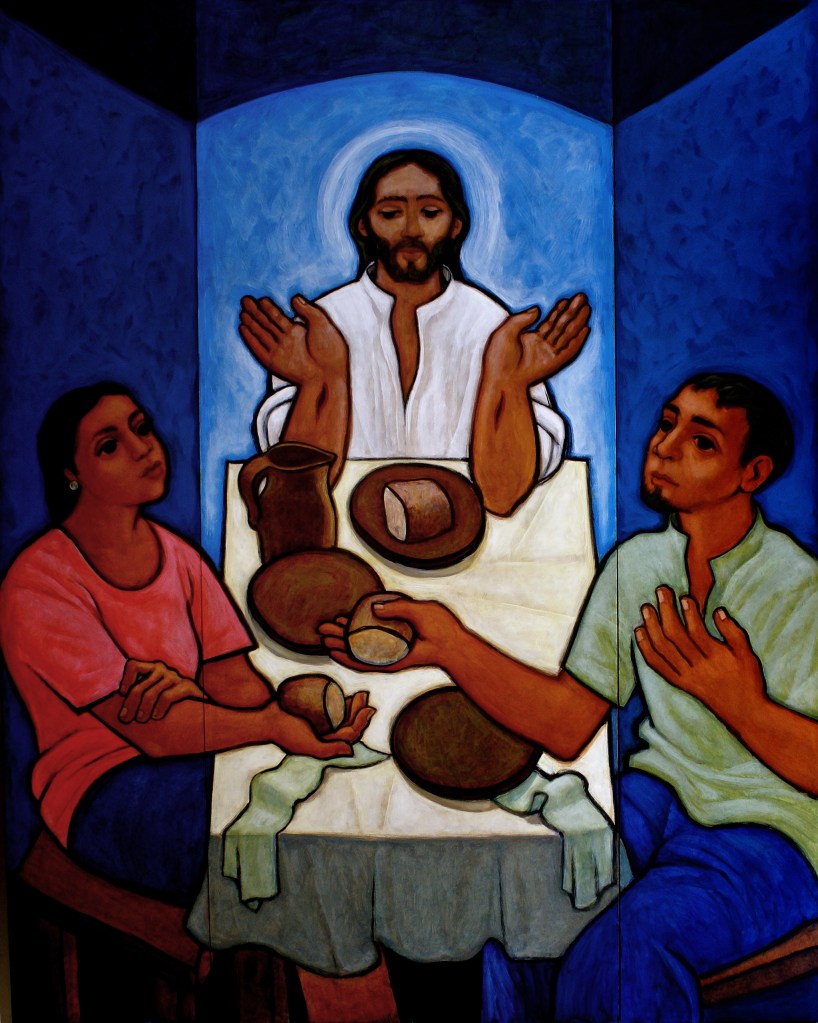
Many modern paintings try to capture the truth of Jesus’s presence now. Below is one from a Spanish artist.
(James Tissot’s “Disciple’s on the road to Emmaus”)
Sunday we talked about all of the stories that happened after Jesus’s resurrection and what they might mean: his disciples recognized him, though not always at first; he could walk through walls; he still had his scars; he ate meals with his disciples and even cooked them breakfast; he still took time to entertain doubts, explain, and teach. In 1 Corinthians 15:35-49 Paul talks to the congregation about how one day we will all be changed, be transformed in an instant into glory (you ought to read this whole chapter again). It would be tempting to forget everything else, the craziness of the here and now, and just wait for that moment. But Paul ends up making quite a different point with a big “therefore”. He says, “Therefore, get busy with life, doing your work in the Lord because now you know it matters.”
Something worth thinking about. One contemporary writer has made this comment (particularly look at the last paragraph) that clarifies and expands one point we talked about Sunday:
The ‘here and now’ is where Paul ends up. You might think, after a spectacular chapter like this one, that he would conclude by saying something like, ‘So let’s rejoice at the wonderful hope we can look forward to!’ But he doesn’t. And this isn’t just because he is a solid and sober practical theologian, true though that is. It’s because the truth he has been expounding, the truth of the resurrection of the dead and the transformation of the living, is not just a truth about the future hope. It’s a truth about the present significance of what we are and do.
If it is true that God is going to transform this present world and renew our whole selves, bodies included, then what we do in the present time with our bodies, and with our world, matters. For far too long many Christians have been content to separate out future hope from present responsibility, but that is precisely what Paul refuses to do. His full-bodied doctrine and promise of resurrection sends us back to our present world, and our present life of bodily obedience to our Lord, in the glorious but sobering knowledge (as we saw in 1Cor 6.14, 13.8-13 and elsewhere) that, if there is continuity between who and what we are in the present and who and what we will be in the future, we cannot discount the present life, the present body and the present world as irrelevant.
On the contrary. It is a matter of the greatest encouragement to Christians, most of whom are away from the public eye, unsung heroes and heroines, getting on faithfully and quietly with their God-given tasks, that what they do ‘in the Lord’ during the present time will last, will matter, will stand for all time. We can at present have no idea how God will take our prayer, our art, our love, our writing, our political action, our music, our honesty, our daily work, our pastoral care, our teaching, our whole selves — how God will take this and weave its varied strands into the glorious tapestry of his new creation. That he will do so is part of the truth of the resurrection, and perhaps one of the most comforting parts of all.
I thought we would use a simple blog site to post info, and (hopefully) have it set up for comments. We can also post pictures and calendars and other useful info.



 Canvas DGroup Journey